
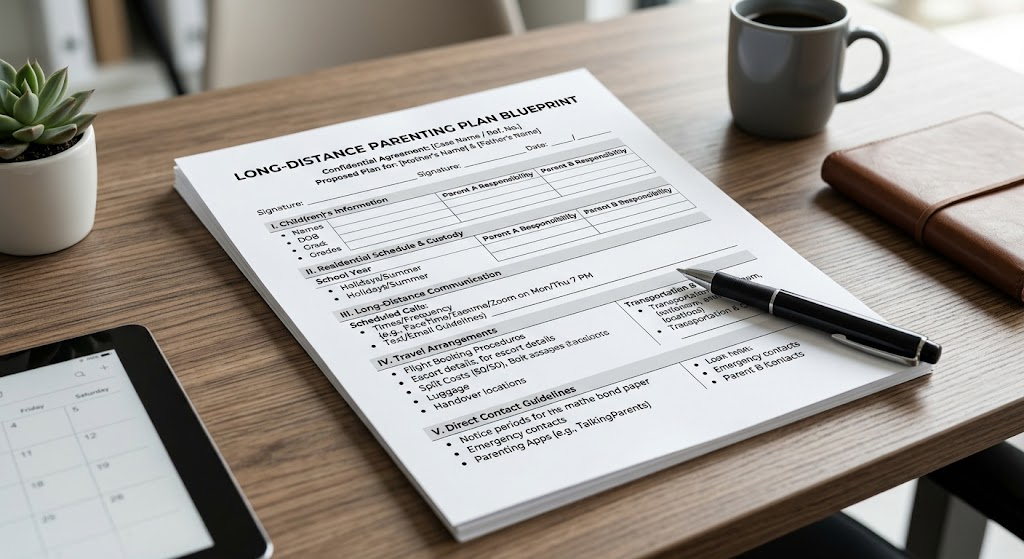
When a Maryland court considers a relocation, the quality of the proposed schedule can decide whether the arrangement is workable. Parents often say they will “make it work.” Judges need to see how. This blueprint turns that promise into something concrete.
The legal framework behind it is covered here: https://www.houlonberman.com/blog/maryland-child-relocation-laws/
Why the plan matters
A credible plan for extended summer and holiday time, plus regular video contact, can make a move easier for a court to accept. A vague plan does the opposite. And when a move is approved, the details of the new schedule often determine whether the arrangement actually works for the child.
The six parts of a strong plan
1. Extended blocks, not frequent short visits. Summer and school-break blocks usually serve a child better than many short trips.
2. A specific holiday rotation. Name dates and times.
3. Transportation. Who travels, who pays, and who accompanies younger children.
4. Predictable contact between visits. Set times for video or phone calls.
5. Information sharing. School portals, medical updates, and activity schedules available to both parents.
6. A process for changes. How far in advance a parent must notify the other of travel or schedule changes.
A fill-in template
Copy this into a document and complete every line:
| Item | Your proposal |
|---|---|
| Summer block(s): start date, end date | |
| School breaks: which breaks, with which parent | |
| Holiday rotation: each holiday, odd or even years | |
| Who travels at each handoff | |
| Who pays travel costs, and how they are split | |
| Who accompanies a younger child | |
| Weekly call or video times | |
| School and medical access for both parents | |
| Notice period for schedule changes |
If you cannot fill in a line, that is a gap the other side or the court will notice.
The stress test
Before you file, check your plan against these questions:
- Does it honor the child’s school year? Look at the calendar of the new school, not just the old one.
- Is it affordable in practice? Travel cost and logistics are part of feasibility. Plans that look generous on paper but are unaffordable will not hold.
- Does it protect the other parent’s relationship? The more a move reduces regular contact, the stronger the justification needs to be.
- Would it still work in a bad month? Think about illness, missed flights, and work conflicts. A good plan has a way to handle them.
- Could the other parent reasonably accept it? If you were on the other side, would you?
Be careful with mediation shortcuts
Mediation is common in Maryland custody disputes and can be faster and less costly than a contested hearing. But a mediator must stay neutral and cannot act as an advocate for either side. Before you sign any mediated agreement, have an attorney who represents your interests review it. And if there is an agreement, ask the court to approve a modified order so it is enforceable.
Mistakes that sink otherwise good plans
- Relying on verbal promises that never reach a court order
- Moving before the agreement is in place
- Offering only a general willingness to be flexible
- Writing messages you would not want a judge to read
Bottom line: a long-distance plan is persuasive when it is specific, affordable, and centered on the child’s relationship with both parents. An attorney can help tailor it to your order and your court. This article is general information, not legal advice.